Feed on
Posts
Comments

EnvisionIT: Enhancing Transition through Technology

Margo Vreeburg Izzo, PhD, Program Director of the Transitions Services Department at The Ohio State University (OSU) Nisonger Center

Wednesday, January 25th, 2017 – 4:00pm to 5:00pm EST

In this webinar, Dr. Margo Vreeburg Izzo will present a 21st century online curriculum aligned with standards and designed for grades 8-12. The curriculum teaches English and language arts, information technology literacy, college & career readiness, and financial literacy. EnvisionIT was designed with accessibility and universal design for learning in mind and is highly customized to meet the needs of students, teachers, and other stakeholders.

Do you have an idea for innovative technology that can improve lives of people with disabilities? NIDILRR’s Small Business Innovation Research (SBIR) program can help.

This year, NIDILRR’s SBIR program will fund up to ten Phase I feasibility (or proof-of-concept) projects for approximately six months (for up to $100,000 each). After completion of the Phase I stage, most of these businesses can compete for Phase II awards. Phase II awards can last up to 24 months for a total of up to $575,000.

Please visit: http://www.grants.gov/web/grants/view-opportunity.html?oppId=290044, or go to www.Grants.gov and search for “NIDILRR SBIR

NIDILRR’s SBIR program is unique among SBIR programs in that it focuses solely on the development of  knowledge, products and services that benefit the lives of people with disabilities.  The purpose of the broader SBIR program is to: stimulate technological innovation; increase small business participation in federal research and development; foster and encourage participation by minority and disadvantaged persons in technological innovation; and increase private sector commercialization of technology derived from federal research and development.

NIDILRR’s SBIR program holds one annual Phase I and one annual Phase II competition:

  • Phase I – The objective of Phase I is to determine the scientific or technical merit and feasibility of the proposed research or research & development (R/R&D) efforts. The Phase I period concentrates on the R/R&D efforts that prove the scientific or technical feasibility of the approach or concept.  This feasibility is a prerequisite for further support in Phase II. Phase I awards are for periods up to 6 months in amounts as indicated in the Funding Opportunity Announcement.
  • Phase II – The objective of Phase II is to continue the research or R&D effort initiated in Phase I with approaches that have commercialization potential as a result of successful Phase I awards. Phase II awards are for periods up to 2 years in amounts as indicated in the Funding Opportunity Announcement.
  • Applications are due February 7, 2017.
  • Letters of Intent are due: January 13, 2017
  • Date for Informational Pre-Application Meeting: January 4, 2017

For more information please contact:  Brian Bard: email: brian.bard@acl.hhs.gov, phone: 202-795-7298
ED Releases Final Regulations Under Part B of IDEA

On December 12, the Department of Education released the final regulations under Part B of the Individuals with Disabilities Education Act (IDEA). These regulations are aimed at promoting equity by targeting widespread disparities in the treatment of students of color with disabilities.  The regulations will address a number of issues related to significant disproportionality in the identification, placement and discipline of students with disabilities based on race ethnicity.  The Department is also releasing a new Dear Colleague Letter addressing racial discrimination.  IDEA requires states to identify districts with “significant disproportionality” in special education – when districts identify, place in more restrictive settings, or discipline children from any racial or ethnic group at markedly higher rates than their peers.  This rule sets a common standard for identifying significant disproportionality in representation of students within special education, segregated school settings, and in receipt of disciplinary actions and ensures that school districts where disproportionality is found carefully review their policies and practices to determine root causes and whether changes are needed.  Also, the Office for Civil Rights (OCR) released a new policy document to support educators and administrators as they work to identify students’ need for special education.  The new policy document was created to remind states, school districts and public schools of their legal obligation to prevent discrimination on the basis of race in special education.  OCR’s enforcement experience suggest both over-identification and under-identification based on race are occurring in schools.  For more information: http://www.ed.gov/news/press-releases/fact-sheet-equity-idea and http://www2.ed.gov/about/offices/list/ocr/letters/colleague-201612-racedisc-special-education.pdf.

Twas’ a tough choice to narrow down this week’s most thrilling AT news, but I think this is a pretty good representation of the best. Which story do you like best?

The Hawkeye Is The Adhesive, Eye-Tracking Phone The Internet Asked For

Aira uses smart glasses to help blind people navigate the world

First real-life study to provide data on the potential of powering medical implants with solar cells

Personal Assistant Mobile App to Assist with Identifying Objects

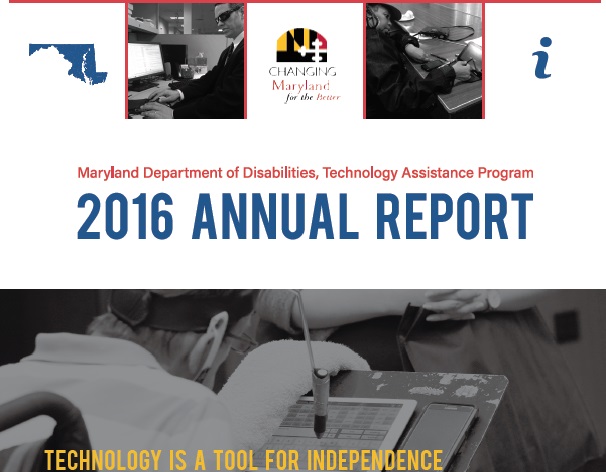
All the best of MDTAP 2016, wrapped up right here in stories, images, and data in the 2016 Annual Report.
Snapshot of Annual Report cover


Funding AT for K-12

Chris Gibbons, Smartbox Inc, Vice President of Education and Assessment

Wednesday, January 11th, 2017  –  4:00pm to 5:00pm EST

Assistive technology (AT) can change the lives of students with disabilities, helping them reach their full potential. Yet the rubber meets the road when it is time to pay for AT devices and services, and information about AT funding is often hard to find. In this important webinar, Chris Gibbons will discuss AT funding sources for children with and without IEPs. He’ll provide information on 3rd party funding, offering specific examples and providing participants with useful resources.

« Newer Posts - Older Posts »

MDTAP | 2301 Argonne Drive, Room T17 Baltimore, Maryland 21218| Voice: 410-554-9230 Toll Free ⁄ Voice 1-800-832-4827|Email: mdtap@mdtap.org